


Quantcast
  
Home
Customer Service
Event Calendar
Online Exclusives
Event Coverage
Product News
From the Magazines
Hot News
On the Flightline
Article Archives
Videos
The Radio Control Show
Plans Guide
Builders' Bash
Blogs
Forums
Related Links
Site Search
Contact Us
DEBRA CLEGHORN
Executive Editor
click here
GERRY YARRISH
Senior
Technical Editor
click here
JOHN REID
Senior Editor
West Coast
click here


New Document

Plans Directory
360+ of the best Model Airplane News plans at your finger tips

Click here to download a PDF Plans Guide of the 360 most popular plans available at AirAgestore.com
Clear off that building board; the hardest part now will be choosing which model to create first.

For a collection of construction articles please see below.


You Can Build a Top Gun Plane!
Several of the 2010 Top Gun entries were built from Model Airplane News plans—including the overall winner, David Wigley’s Westland Wyvern! If you have the patience and determination to build a Top Gun airplane, we’ve got the plan!

Click here

GIANT BRONCO OV-10 A
Designed by Rich Uravitch, this giant-scale, twin-engine, flap-and-retract-equipped warbird is economical to build (conventional balsa and ply) and definitely fun to fly. There are many viable and colorful paint-scheme options for this impressive model, and Rich offers formed-plastic parts for it (prices and ordering details are printed on the plan).
Download the article...


Buy it now!


ELECTRO HOTS
This newest rendition of the famous Hots design family takes lightweight construction to the limit. Using traditional balsa, plywood and lite-ply, Steven Santich, the son of Dan Santich-the designer of the original Hots, has produced a modern 3D flying machine that has single digit wing-loading! Ideal for the intermediate to advanced builder/flyer.
Download the article...


Buy it now!


CONVAIR 440 / C-131 SAMARITAN TRANSPORT
Designed and built by Geiyer "Andy" Anderson, the Convair 440 / C-131 Samaritan Transport is an excellent flying sport scale twin designed around a pair of O.S. .32 2-stroke glow engines. The Samaritan uses traditional balsa and lite-plywood construction and is designed to use off-the-shelf retracts and shock absorbing struts from Robart Mfg. The wing is equipped with flaps and uses a pilot friendly semi-symmetrical airfoil.
Download the article...


Buy it now!


SHOESTRING
The yellow and red Shoestring has always been one of my favorite airplanes and over the years, I’ve built several free-flight and U-control versions, all of which were great flyers. A few years ago, I started thinking about building a small RC Shoestring in a Speed 400-size. With the growing popularity of brushless motors and LiPo battery technology being what it is, I decided to forge ahead.
Download the article...


THE MICROWAVE
Designed by Rich Uravitch, this electric ducted fan design uses recycled EDF power units from worn-out foamy jets for power. The plans include a long- and a short-wing version so you can build a cruiser or an interceptor. Formed plastic parts and laser cut wood parts are available.
Download the article...


Buy it now!


FIESLER STORCH
Designed by Rob Caso, the Fieseler Storch was a German Luftwaffe STOL aircraft that was used extensively throughout WW2. Rob’s 1/12-scale model is electric powered and highly detailed and features functional shock absorbing landing gear and Leading Edge Wing slats for amazing slow flight. It uses former and stringer balsa and ply construction throughout.
Download the article...


Buy it now!


THE STRIKE
An electric-powered EDF version of the author's original design, The Strike is Joe Beshar's newest incarnation of his popular Shrike. It uses basic balsa and plywood construction and is fairly easy to build. Intended for intermediate pilots, The new Strike is a good sport Electric Ducted Fan flyer that uses 3S 11.1V LiPo battery packs.
Download the article...


Buy it now!


GEE BEE MODEL-D
Designed by expert model designer and builder Pat Tritle, this lightweight electric-powered, sport-scale Gee Bee Model-D is intended for intermediate to expert pilots. The model uses traditional balsa and plywood construction, a laser-cut short kit is available from the author.
Download the article...


Buy it now!


SKY KING CESSNA 310 SONGBIRD
Designed by Rich Uravitch, this twin electric is a straightforward build and a stable flyer. It uses conventional wood construction methods and laser-cut wood parts and formed plastic parts are available from the author.
Download the article...


Buy it now!


L-19 GLOWDOG
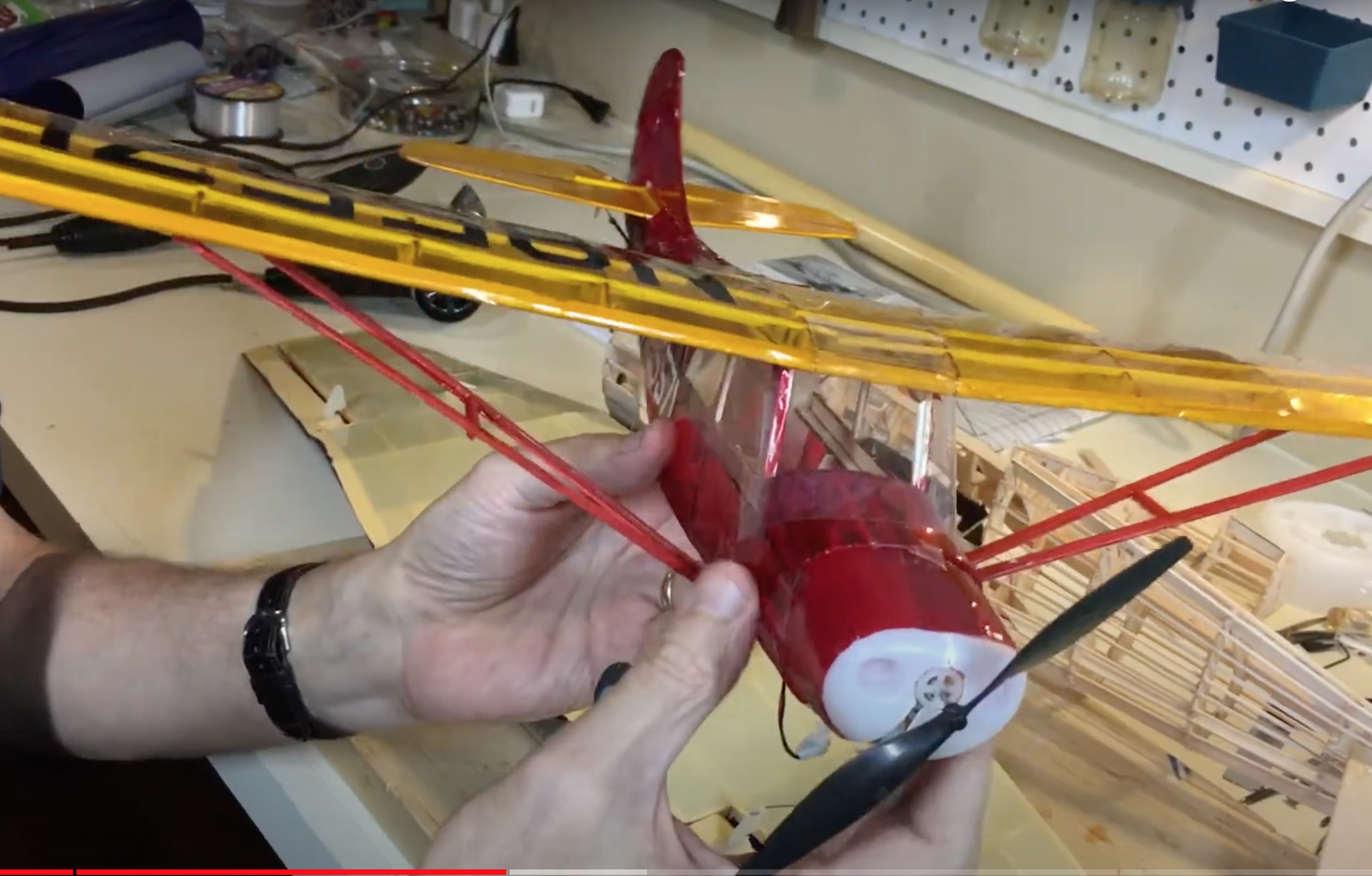
Designed by Keith Sparks, the L-19 Glowdog is a sport-scale Cessna observation plane that is not only a nice, easy-to-fly park flyer, but it is also a great night flyer. Constructed of thin, lightweight Depron foam sheet material and lite ply, the airplane is translucent and designed to light up. Download the article...


Buy it now!


TWIN JET JOB
Designed by Dick Sarpolus as a quick-to-build, easy-to-fly EDF jet, the “Twin Jet Job” is made almost entirely out of DowCor Fan-fold insulation foam. It uses an inexpensive power system and basic hardware and is a great first jet. The plans are also available for free download at the “From the Magazine” section at the modelairplanenews.com website. Download the article...


Buy it now!


GEE BEE MODEL-Y SENIOR SPORTSTER
WHEN YOU SHOW UP AT THE FIELD WITH THE SENIOR SPORTSTER, EVERYONE WILL STOP FLYING JUST TO WATCH
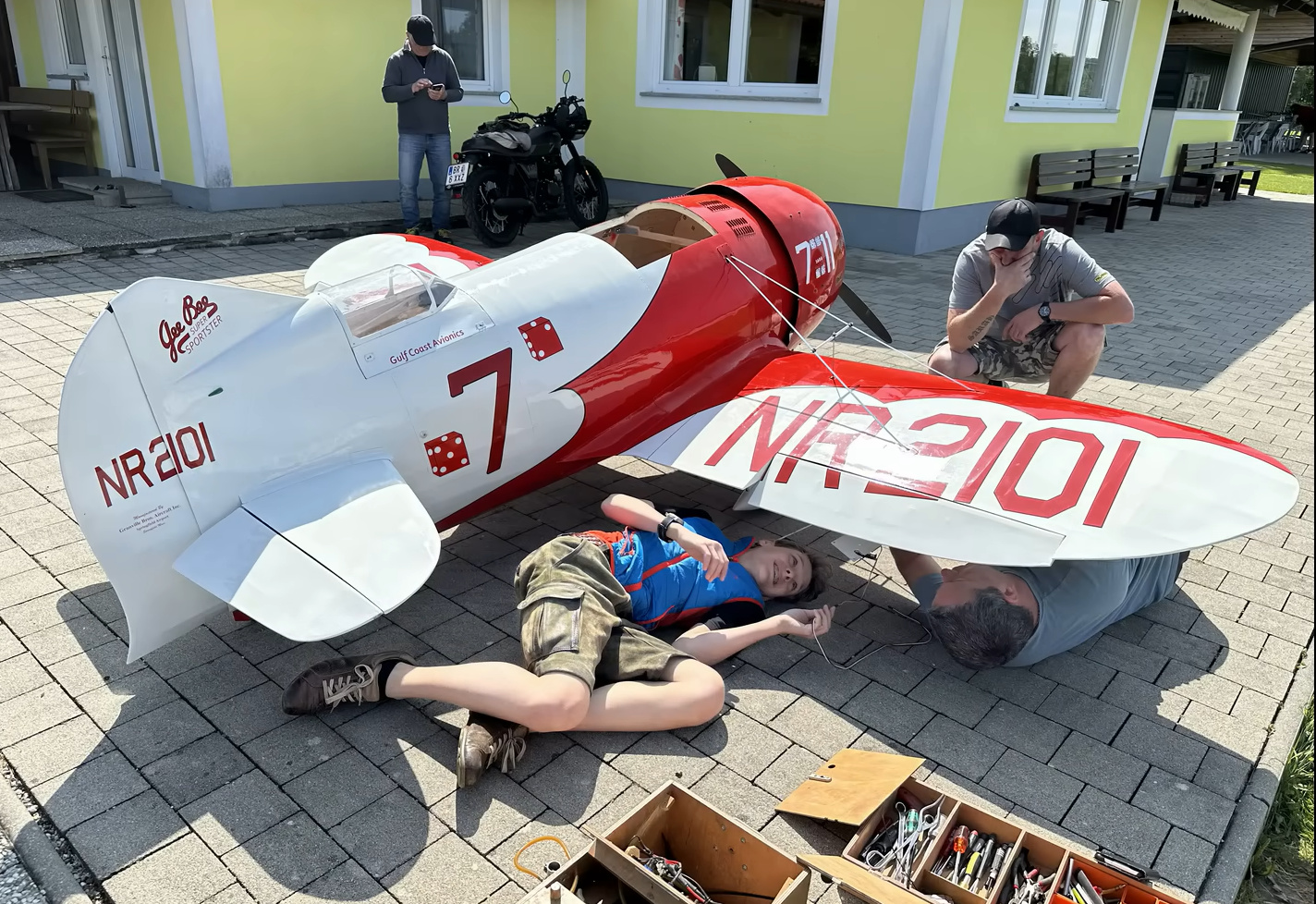
When talking about Gee Bees, nine out of 10 modelers envision the Granville Brothers' big, round Model R-1-the fastest and deadliest plane of its day. Maybe a few would even know that Jimmy Doolittle flew it. Only a few diehard history buffs even know about the earlier Gee Bee versions. In today's world, where it is common to find women piloting everything from airliners to space shuttles, many readers will be interested to know that back in the early days of aviation, there were several very successful female Gee Bee pilots including Maude Tait. Read more...


Buy it now!


DOUGLAS A-26 INVADER
DESIGNED AS A LOW-LEVEL attack bomber, the Douglas A-26 Invader first flew in 1942. Powered by two Pratt and Whitney R-2800 radials, it carried a variety of weapons from .50-caliber machine guns and rockets to a cannon. During the end of WW II, the Invader earned a reputation as a hard-hitting, durable weapons platform. The Invader soldiered on through the Korean conflict, operating mostly in night attack roles, but by the early 1960s most had been retired or converted into fire bombers. When the Vietnam War broke out, the tried and battle-tested A-26 came out of retirement for a third tour of duty converted into counter-Invaders, designated B-26Ks, used mostly for counterinsurgency missions. Read more...


Buy it now!


AEROMARINE EO SPORT BOAT
WHAT IS IT? That's the most common question asked of my friend Larry whenever he brings his Aeromarine Tractor Sport Boat to the flying field. Larry is used to the question, though, as he has been scratch-building his own scale projects for years. He loves unusual, seldom seen airplanes and this one is no exception. Although the Aeromarine is close to scale, Larry builds his planes for casual sport/fun flying and not for serious scale competition. One thing is for sure: you're likely never to run into another Aeromarine EO Tractor Sport Boat at the flying field!
Read more...


Buy it now!


WILD HOTS
THE WILD HOTS has a lineage that goes back 27 years. In 1982, my father, Dan Santich, designed the original "Hots" to compete at local fun-fly events. At that time, there were no kits or laser-cutting services available, but his model became very popular and hundreds were built and flown. It was intended for advanced fun-fly aerobatics that were akin to what we now call 3D flying. "This airplane is a different breed," he said. He expanded the line and many "Hots" variants soon followed.
Read more...


Buy it now!


SPITFIRE MK. 1
ENGLAND, 1940: as the sun rises over the grass airfield, you scramble to your Spitfire, sirens wailing and your crew chief waiting. Within seconds, you are strapped in, chocks are away and you advance the throttle of your mighty Merlin engine. Skip forward 67 years, and you can realize your dream of becoming a Spitfire pilot by building this electric sport-scale, all-wood Spit.
Read more...


TURBINATOR-E
OVER THE YEARS, I have designed and built a number of RC ducted-fan models. Due to my close association with the late Bob Kress, these models ranged in power size from .049 to .90 cubic inches. With current electric power technology being so efficient and practical, I decided to make a smaller electric-powered version of my 72-inch-span turbine-powered Turbinator jet. I designed the prototype Turbinator-E to be powered by the Astro brushless 020 motor/Wemotec 480 Mini Fan system offered by Astro Flight. It had a 44-inch wingspan and used a 3-cell LiPo battery. This combination flew OK but not as I would have preferred. I changed to a 45A ESC and a 4-cell 2100mAh FMA LiPo battery for a great increase in performance. I have also used the High End Technology RC 6904 ducted fan with the Astro Flight 020 803MS motor on 4 cells with very good results. Read more...


Buy it now!


BRITTEN-NORMAN DEFENDER 2000
THE DEFENDER is an unlikely moniker for an aircraft that seems like it could trace its lineage to an overland cargo trailer with wings. It's clearly designed for utility rather than aesthetics: square edges rather than curvy lines, a rectangular rather than sleekly tapered wing planform and a funny looking twin-wheel landing gear system. The phrase it's got a great personality comes to mind! So, with all these qualities, what makes the breed so successful? In reality, the Defender is a stretched version of the Britten-Norman Islander, the airplane you see in use everywhere in the islands and small countries in commuter airline and short-haul utility roles. Its boxy lines spell function; no valuable space is given away in the interest of slippery looks. Read more...


Buy it now!


LUTON BLUE CHIP & FORERUNNER
THE INSPIRATION FOR these models came from a construction article for a rubber-powered model of the Blue Chip that was published in Model Aviation many years ago. The model had horizontal stabilizer and elevator areas that were quite large for a race plane. Their general layouts looked like they would produce a good RC sport model. A bonus was that these were unique designs never before flown by RC. Read more...


Buy it now!


WESTLAND WYVERN S4
THE WESTLAND WYVERN occupies a unique position in aviation history. Few British aircraft have achieved as many firsts as the Wyvern. It was the world's first turboprop combat aircraft and was the first turbine-powered airplane to serve on aircraft carriers. It was the heaviest single-seat combat aircraft in British service at the time and used the first eight-bladed contra-rotating propeller system developed in the U.K. Read more...


Buy it now!


LOCKHEED YO-3A QUIET STAR
IF YOU LIKE military planes and gliders, you are in luck. I stumbled on the Lockheed YO-3A Quiet Star in the October 2006 issue of Flight Journal, the sister publication of Model Airplane News. The YO-3A was used in Vietnam to spot and mark targets so that smart bombs could hit them. The plane's only defense was the darkness of the night skies and silence. Its operating sound levels are still classified. In my opinion, the YO-3A was the first stealth military plane produced. Information on this airplane was very sparse at best and to my knowledge this is the first RC version of this subject. Read more...


Buy it now!


HAWKER HURRICANE
THE HAWKER HURRICANE is one of the most recognizable British WW II fighters for its ungainly yet attractive lines. Its thick wing, wood-framed fuselage, and humpbacked appearance made for a unique fighter aircraft look. Nimble, fast, and strong, it was a good match for the Luftwaffe's Bf-109 and the Fw-190. Read more...


Buy it now!


1940 TAYLORCRAFT BL-50
II HAD MY VERY FIRST airplane ride in August 1944; the airplane was a 1940 Taylorcraft BL-50. Shortly after I turned 16 years old, I received my first lesson in the airplane and soloed in it a month later. After I had become seriously involved in scale RC modeling, I wanted to build a model of the Taylorcraft I learned to fly in, but I could not find any photos to use to document its markings. Many years later I found an article in the E.A.A. Sport Aviation magazine featuring the 1994 Oshkosh Grand Champion, which happened to be finished in exactly the same blue and silver aircraft markings as my Taylorcraft but with different registration numbers. This particular paint scheme was often used with aircraft in the Civilian Pilot Training Program of the early 1940s so it isn't often seen. Another unique feature is that it had its engine cylinders exposed similar to a J-3 Cub; most Taylorcraft aircraft after 1940 to '41 had enclosed engine cowls. Read more...


Buy it now!


CURTISS JENNY
WHEN IT COMES TO scale park flyers, old biplanes are very hard to beat. And when the subject of old biplanes comes up, the Curtiss Jenny is one of the first planes that most airplane buffs think of. There's no doubt that the Wright Brothers invented the airplane, but it was Glenn Curtiss who perfected it! Read more...


Buy it now!


AERONCA C-3
MY FIRST RC MODEL of the Aeronca C-3 series was the Dennis Bryant-designed C-3 Master. I used the model for competitive events, but my documentation was not very good and its static scores were pretty poor. I then swapped some documentation on the Fokker Dr. 1 Triplane for a booklet entitled Historical Aviation Album, Volume X. Inside was the early history of the Aeronca Company along with some very good drawings by Paul R. Matt and lots of photographs of the Aeronca C-2 and C-3. I soon realized that the scale drawings were the ones that Dennis had used when drawing up his plan and when I started to use them in my documentation pack, my static scores improved tremendously. Read more...


Buy it now!


THE BUSTER STUNTER
THE BUSTER was Steve Wittman's first Goodyear racing airplane. It was built from the wreckage of his first closed-course racing airplane, the Chief Oshkosh, that was first raced in 1931 at the Cleveland National Air Race. Buster raced in the inaugural Goodyear Trophy Race in 1947 and won first place. This was followed by a second first-place win in 1948 and another in 1949. Its speed increased steadily from 165.9 mph in 1947 to 177.3 mph in 1949. The airplane was finally donated to the Smithsonian Air & Space Museum in 1954. Read more...


Buy it now!


3D F4F WILDCAT
MY GOAL WITH THIS all-foam F4F Wildcat was to create an airplane that looks like a warbird while having 3D flying capability. The Wildcat is easy and inexpensive to build, it flies well in 15 to 20mph breezes, and it?s durable. Apart from the motor and electronics, it costs about $10 or $15, depending on where you buy the foam. Read more...


Buy it now!


T-38 TALON
WITH ITS SLEEK LINES and long curvaceous fuselage, the Northrop T-38 Talon (nicknamed the White Rocket,) is often regarded as one of the most beautiful airplanes of all time. But unfortunately for modelers, it is not an easy airplane to model because of its small wing and long, curvy fuselage. The emergence of lightweight sheet-foam construction, high-powered electric motors, and lithium-polymer (LiPo) batteries has changed that. Read more ...


Buy it now!


THE WEDGY
WEDGY THE RECORD SMASHER was the title in the November 1940 issue of Model Airplane News. Just a few months earlier, with a 22-minute-plus flight, my original model had won first place in Class A Free Flight at the 1940 National Championship in Chicago, IL, setting a new record. Nine versions were built and tested before I homed in on this winning version. It placed in the top three in every contest in which I entered it. Read more...


Buy it now!


MIDGET MUSTANG
WHEN I HEARD that a local club was racing .25-powered models, I dropped in to check out the activity. The two model types that seemed to dominate the pits were two of my old designs that were kitted by House of Balsa the T-6 Texan and P-51 Mustang. Flattered by the popularity of the designs, I thought, How about a .25-powered Goodyear/Midget class racer? Or maybe a Minnow, Shoestring, Rivets or Midget Mustang? Read more...


Buy it now!


THE EAGLE 7
MOST JET ENTHUSIASTS like scale models that capture the excitement and thrill of full-scale aircraft. There's an endless variety of kits available for almost any scale jet you might like to build, so why design and scratch-build a jet that's not scale? I designed the Eagle V sport jet three years ago (published in the December '04 and January '05 issues of Radio Control Modeler magazine) to prove that an all-wood entry-level jet could have the performance of one of those expensive fiberglass models. I built several Eagles from the plans, and from the feedback I received, all who've built the model were satisfied. Read more...


Buy it now!


3D HOT HOTS
IF YOU WANT TO BE ABLE to do anything wild 3D maneuvers, fun-fly competition or burning big holes in the sky the 3D Hot Hots might be for you. It can take off like a guided missile, hover like a helicopter, do clean knife-edge passes, square figure-8s and torque rolls while going fast or slow all with clean, efficient, electric power or a glow engine; that's up to you. Read more...


Buy it now!


DH-88 COMET RACER
THE DE HAVILLAND DH-88 COMET was built as a racer for the 1934 MacRobertson Air Race from London, England, to Melbourne, Australia. Three Comets were in the race but only two finished in first and fourth places. The third, Black Magic, led the race until its engines burned up after being given the wrong fuel in Allahabad. Read more...


Buy it now!


STAUDACHER 300-GS
The Lap Mat Staudacher 300-GS is a sport scale aerobatic plane that is uncomplicated and builds quickly. It has all balsa and ply construction, and the engine cowl is made from balsa and foam covered with glass cloth and epoxy resin.
Download the article


Buy it now!


IMPULSE
Bob Aberle breathed new life into this 1954 Bill Johnke original design by adding RC and electric power. The straightforward, all-wood aircraft is a fast build as well as a great sport flyer and an ideal trainer.
Download the article

Buy it now!


DOUGLAS DC-6
This impressive 4-engine airliner from the 1940s and '50s was designed by Pat Tritle. The model uses traditional lightweight balsa and ply construction with a built-up frame base covered with formers and stringers to give the model its shape. It is not hard to build but requires a lot of time and effort. Laser-cut parts are available from the author.
Download the article


Buy it now!


Also available on these platforms
Search:


Subscribe |  AirAgeStore |  Privacy Policy | Terms of UseAdvertising | Contact Us
Copyright © 2010 Model Airplane News All rights reserved.  | Console Login